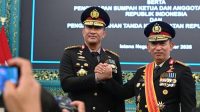
Jabartoday.com-Jakarta, January 22, 2026 — The Central Executive Board of the Indonesian National Youth Committee (DPP KNPI), together with the Non-Aligned Youth Movement (Pemuda GNB), has expressed support for the Indonesian government’s decision under President Prabowo Subianto to participate in the Board of Peace related to the Palestinian issue.
In a joint press statement released at the KNPI Headquarters in Kuningan, South Jakarta, KNPI stated that Indonesia’s involvement aims to help consolidate a permanent ceasefire in Palestine, support the reconstruction of Gaza, and advance a just and sustainable peace based on the Palestinian people’s right to self-determination and statehood in accordance with international law. This effort is expected to contribute to broader regional security and stability.
Chair of the Non-Aligned Youth Movement, Tantan Taufik Lubis, said the Board of Peace has become relevant amid the long-standing structural deadlock of the Palestinian issue, where UN resolutions remain unenforced, multilateral mechanisms are weakening, and major powers are often part of the problem. He emphasized that Indonesia’s presence in the Board of Peace offers an opportunity—albeit limited—to inject a Global South perspective, reinforce humanitarian considerations, and prevent the Palestinian issue from being reduced solely to Israel’s security concerns.
While recognizing the decision as a diplomatic opportunity, KNPI and Pemuda GNB also underlined the potential foreign policy risks and domestic implications. Accordingly, they presented eight critical notes.
First, the Board of Peace is an institution initiated by U.S. President Donald Trump, initially designed to oversee post-conflict reconstruction in Gaza. However, its draft charter suggests a broader mandate beyond Palestine, which KNPI views as potentially undermining the constitutional role of the United Nations. KNPI recommends that Indonesia advocate for clear limitations on the Board’s authority, ensuring that all decisions remain coordinated with or approved by the UN.
Second, the Board’s governance structure designates Donald Trump as chair for life unless he resigns or is deemed incapacitated, a provision considered inconsistent with the principle of equality among sovereign states. Third, the appointment of controversial and strongly pro-Israel figures to the executive board raises concerns over conflicts of interest.
Fourth, the Board of Peace lacks a binding legal framework, enforcement mechanisms, or peacekeeping forces comparable to those of the UN Security Council. Its invitation-based membership, limited to around 60 countries, risks domination by U.S., Israeli, and allied interests, potentially compromising Indonesia’s long-standing “free and active” foreign policy.
Fifth, although Indonesia may aspire to act as a stabilizer or bridge-builder, such idealism faces significant challenges, particularly if decision-making relies on voting mechanisms where Indonesia could be marginalized. Sixth, KNPI stresses that Indonesia’s participation must reflect the Spirit of Bandung, the principles of the Asian–African Conference, the Non-Aligned Movement, the Organization of Islamic Cooperation (OIC), the Arab League, and Indonesia’s mandate from the 2023 OIC–Arab League Joint Summit in Riyadh.
Seventh, regarding the requirement for member states to contribute US$1 billion in the first year to secure permanent membership, KNPI urges the government to exercise prudence, considering Indonesia’s fiscal deficit and national debt burden. The organization cautions against taking on new debt solely to cover membership fees.
Eighth, KNPI hopes Indonesia’s involvement in the Board of Peace will not diminish its diplomatic engagement in existing multilateral forums such as ASEAN, the G20, the OIC, the Non-Aligned Movement, BRICS, and the United Nations.
KNPI concluded that Indonesia’s participation in the Board of Peace could strengthen international efforts to halt violence, protect civilians, and expand humanitarian access for Palestinians in Gaza. At the same time, it emphasized that the move carries implications for Indonesia’s ideological consistency in foreign policy. [Fahrus Zaman Fadhly]